
Showing posts with label the book thief. Show all posts

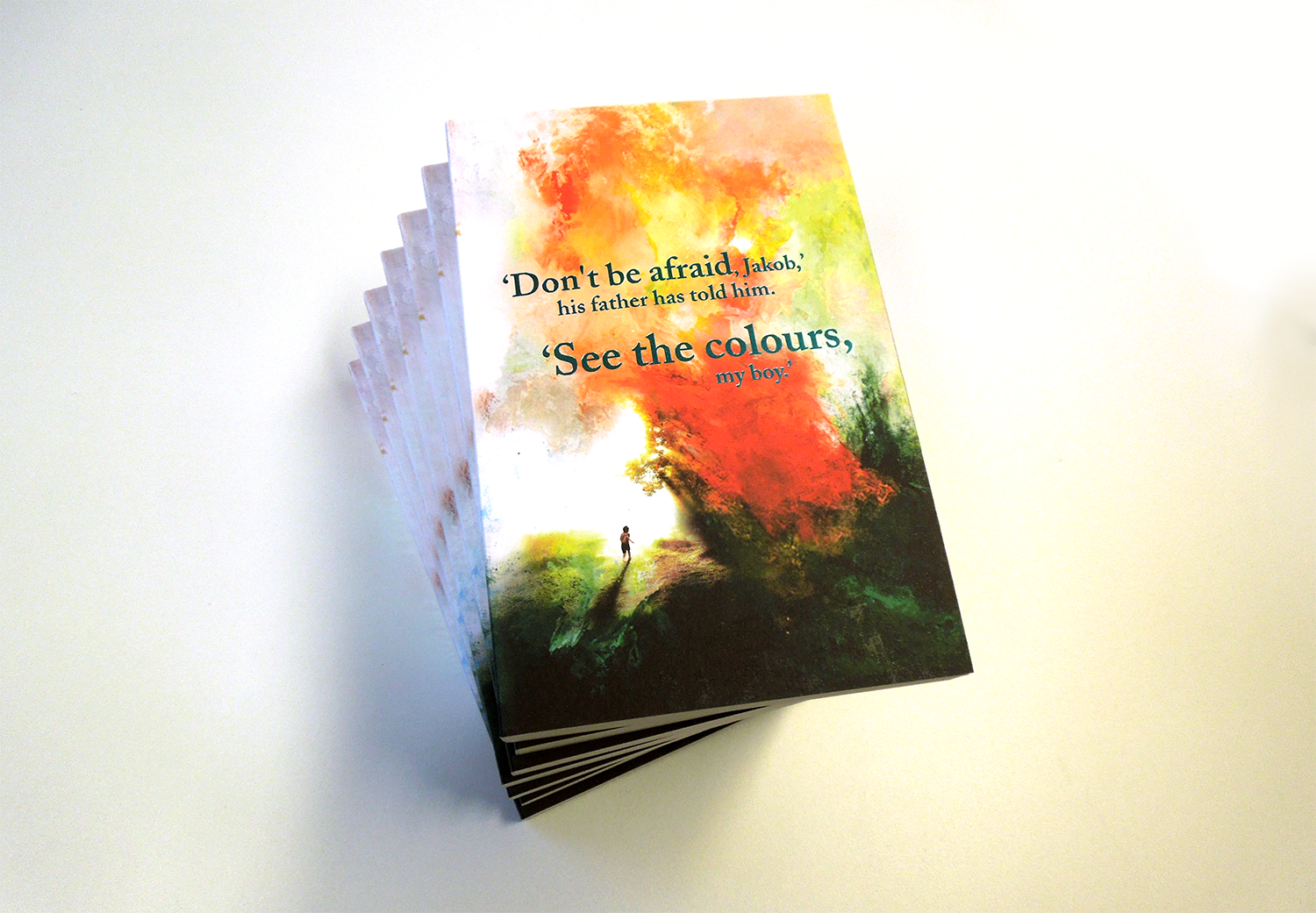
Review: Jakob's Colours


I think it was pretty much a given that I was going to love Jakob’s Colours. I mean, let’s be honest here, it ticks pretty much all my boxes, all of them; everyone knows I love a book that makes my heart hurt. Jakob’s Colours made my heart hurt. I didn’t cry, but then I didn’t cry when I read The Book Thief either; it made me too sad to cry. This was kind of the same thing, I had that kind of hollow feeling at the end, that weird kind of emptiness that comes in part from the end of a book that you’ve just let absorb you and in part from the fact that said book has made you feel too many things to really know what to do with. I didn’t start another book as soon as I finished this one, like I would normally. I kind of just needed some time.

Jakob’s Colours is set for the most part in Austria in 1944 and is about Jakob, a little gypsy boy, running like his father told him to do, running because he still just about can, although he has nowhere to run to and is unable to feel anything really, but fear.  Jakob’s father told him not to be afraid, to see the colours, and Jakob does, so brightly that it almost hurts your eyes.
Mixed in with Jakob’s story we get ‘Before’ when Jakob and his Mother and his brother and sister are lost and alone and hiding and searching for his father and we get ‘Long Before’ where we see Jakob’s mother growing up in England, the events that result in her being sent to an asylum where she meets Jakob’s father (a gypsy boy) and how they manage, despite the odds being stacked against them, to build their life together, interspersed with little bits where the family is together that leave you with a knot in your tummy and all of it, it’s all kinds of beautiful. This Day, Before, Long Before, all of it, it’s just stunning; it goes backwards and forwards, from this time to that with a pace that leaves you breathless, as breathless as Jakob is, as he runs.
In the present day Jakob meets Markus – you need to be prepared for that. You just, you really do. If you’ve read The Book Thief then I’m just going to say to you Liesel and Max and leave it at that, because whilst this is in no way the same, the relationship between these two characters invokes the same sort of all-encompassing hurty feeling that you don’t quite know how to express.
  

In a complete contrast to the hollow feeling I got at the end – the last 40 pages or so sat heavy on my chest and although the ending didn’t surprise me, it winded me all the same. STAMP ON MY HEART WHY DON’T YOU LINDSAY HAWDON (I love you) – the whole book was infused with a weird kind of heart, like, it was constantly heartbreaking but not always despairing. Does that make sense? Let me try and explain what I mean. Bad stuff happens in this book, it’s about a holocaust, let’s not be naïve, bad stuff happens and it tears you apart but it’s kind of balanced out by the other stuff, by the beauty, by the colours, by the love. The thing is, I’m not sure if that balance is a good thing, I mean it’s a good thing, but from the point of view of my fragile emotional state perhaps not so much because when Markus is so unbelievably tender to Jakob, when his Mother wraps herself around him at night, when his Father tells him see the colours, my boy, well I’m not entirely convinced that all of that tenderness doesn’t make the hard stuff harder.

This is a book that is full of colour and full of faith and wonder and it hurts. It opened my eyes to gypsy life and culture, and to the gypsy holocaust, which we hear so little about when really we should because, I don’t know, because it matters. They mattered. Up to 1.5million gypsies were killed by 1945 and it went unrecognised until 1982. Just, how? It blows my mind in the worst way possible that just when you think WWII can’t have been any worse, you find out something new and horrific and so terrible you can barely believe it happened at all, except it did and you have to believe it because to not, to shy away, is to do the memory of those people a disservice.  

Jakob's Colours is incredibly beautifully written, the characters so real they made me ache, the descriptions so vivid, and the emotions so raw and honest. This is a book that is going to matter, it’s a book that’s going to open eyes and raise questions and it’s book that should, really, win All The Awards. I didn’t enjoy it because it’s not the kind of book you enjoy, but I loved it. Also, I don’t know what the finished cover looks like, but the proof copy is so damn beautiful good gracious. 

It's out today. Read it.

It Starts and Then It Ends


The Top Ten Tuesday this week - as seen on The Broke and the Bookish deals with the top ten opening and closing line[s], which is a topic that made me go 'ooooh' because whilst the body of a book is obviously of great import, it's how it starts and how it finishes that counts. If it starts awfully then you might not read past that first line and likewise if the ending leaves a bad taste in your mouth then it can taint the whole experience. Also, it made me have to do thinking and remembering because it's not just 'oooh that was a book I liked' it's 'how did it start and how did it finish and were either of those things better than all the other books?' 

What a fun way to spend a lunch break, hey?

And so (never in any particular order):

1.       I Capture The Castle – I write this sitting in the kitchen sink. 
Best opening to a book ever. Possibly. Not only is it a super opening, because let us be real here, who doesn’t want to know what happens after that, it’s also a really great quote. It’s really a really great book too, which helps.

2.       A really great book with a very good end: “Only the margin left to write on now. I love you, I love you, I love you.”

3.       Mr. and Mrs. Dursley of number four Privet Drive, were proud to say that they were perfectly normal, thank you very much. 
It’s an opening that hooks you in, because you want to know more about these Dursley folk and what it is about them that makes them feel they need to proclaim their normality.  More than than though that it’s what it represents: the first sentence to a series of books that has changed lives; that changed mine.

4.       Life of Pi  “Very few castaways can claim to have survived so long at sea as Mr. Patel, and none in the company of an adult Bengal tiger."
I loved Life of Pi; I loved the journey the book took me on and I loved how the conclusion made me question everything I’d read. The ending just felt right.  

5.      Looking for Alaska: "Thomas Edison’s last words were: 'It’s very beautiful over there.” I don’t know where there is, but I believe it’s somewhere, and I hope it’s beautiful'."  
John Green, you’ve done it again and I love you. Looking at this book as a whole, making the last words 'last words', is genius and these last words are perfect.

6.       The Graveyard Book “There was a hand in the darkness, and it held a knife.”
I love you Neil Gaiman, talk about building suspense from the very first second.

7.       Deathly Hallows: All was well."
*uncontrollable sobbing* [FYI the epilogue will forever displease me but these three words? God, the first time I read this book they slayed me.]

8.       TKAM: He turned out the light and went into Jem's room. He would be there all night, and he would be there when Jem waked up in the morning."
I just love the whole thing, honestly. Wouldn’t change a word.

9.       The Book Thief: "A LAST NOTE FROM YOUR NARRATOR. I am haunted by humans."
I am haunted by humans.  I will never be over this book. If you haven't read it, then read it. You need to have read it, and felt it, and lived it to understand why this ending is so heart-hurtingly perfect.

10.   The Blind Assassin: Ten days after the war ended, my sister Laura drove a car off a bridge." 
 A good opening line makes you want to know the story. Even now, when I know the story, this opening line makes me want to read on. I love this book so hard.

Top Ten Books Dealing with Difficult Subjects


This week’s topic for 'Top Ten Tuesday' (yes, I know it's Friday. Whoops.) was ‘Top Ten Books Dealing with Difficult Subjects’ which plays right into my hands actually, because I read rather a lot of books dealing with difficult subjects. I was practically rubbing my hands together because books that are challenging and emotive and punch me right in the feels? Those are the kinds of books I can’t seem to not read.Often I'll be in a bookshop and Helen will call out to me from the other side of the shop, 'hey, Jo, this is a book about Hitler, you'll love it' and I'll be able to feel everybody's eyes on me as I look around cagily and protesting, like some kind of confused Tinkerbelle: I don't love Hitler, I don't, I don't. 

What I do love is being affected by a book. I don't always want to read a book, smile and say 'well, that was good' before moving onto the next one. I like a dystopia that makes me think; I like characters that are raw and funny and human and palpable; and, I like books that break my heart and stay with me for days.

So, have at it. The best of the bunch (today at least):

 Cancer is a difficult subject. Pretty much every person ever has been affected by it to some degree and you can’t get away from the fact that it sucks. The thing I love about John Green – scratch that, one of the things I love about John Green – is that he doesn’t shy away from that. He doesn’t pretend it doesn’t suck.  He doesn’t pretend it’s all going to be ok.  He lets these two very real characters fall crazy in love regardless. It’s a beautiful story, all the more so because it hurts.


 Wasted: This incredible book about Myra Hornbacher’s struggle with eating disorders is the very definition of a book dealing with a difficult situation. It’s raw and hard-hitting, it pulls no punches. It's so brave too. Hornbacher really does bare her soul inside the pages, so it feels.


 The Book Thief is one of my favourite books of all time. Set in Nazi Germany, it broke me into tiny pieces. I love it so much I daren’t re-read it.  I have no words.


Rape and racial inequality – does it get much more ‘difficult’ than that? This is a book that changes you – it makes you think, really think. The best time I ever had at school was studying this and I’ve read it countless times since. Also, Atticus.


 Aaah, Perks. This is another one of those books that just made me feel so many things. It’s so so so well done.


The Cellist of Sarajevo: If you haven’t read this then you should. This story is that of a cellist – based, I believe, on Vedran Smailovic -  who played for 22 days as snipers fought each other in the buildings surrounding him during the Siege of Sarajevo in the 1990’s. It will make you bone crushingly sad but it will also fill you with wonder.


This book actually broke my heart. I finished it, looked at Iam, said ‘I think I’m sad’ and then just sobbed and sobbed and sobbed. It makes me feel cold just thinking about it. Set in 1941 it follows a teenage Lithuanian girl sent to a work camp in Siberia. It’s incredibly moving; it’s incredibly haunting; it hurts and not even remotely in the good way, it just plain hurts. It feels like ripping open a wound, rubbing salt in it and then jumping up and down on it in spiked shoes. How can I recommend it so highly when I describe it so horrifically? Because it matters, because it matters and because whilst your heart breaks into tiny little pieces and you wonder how the hell this can have happened [ and if you’re me how you didn’t really know: we did a lot on the Nazi Concentration Camps in school but barely even touched on this] you’ll also marel at how love and hope can still bloom even when everything else is so hopeless – the love, the hope, the strength, the determination, the joy. That’s what hurts and that’s what makes this book important.

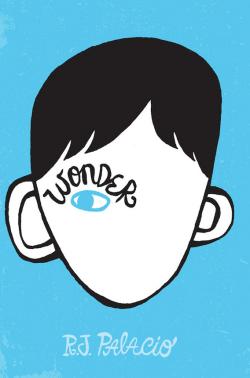
  Wonder is frank and moving and real and so important. Every child, every teenager, every person should probably read this book. This is a book that matters.


Junk won the Carnegie Medal and the Guardian Children's Fiction Award and rightly so. It's the story of teenage runaways who fall into a life of heroin addiction. It's open, honest and upfront - it was slated at the time I think, by critics saying it was encouraging young people to take drugs.  I was a teenager when it eas published and I think it had the opposite effect. Seriously, what Gem and Tar go through, it's not pretty. I think the people that have a problem with books like this really need to have a greater respect for  the target audicence. Drug abuse is a real issue, we shouldn't hide from it and that we need more books like Junk.


  My Sister Lives on the Mantlepiece deals beautifully with loss and what that means, particularly to children. S'good. I think I blogged about it when I read it actually because I thought at the time that it was good at what it did. Children deal with death - grandparents, pets, maybe even a parent or a sibling and it's a hard thing to understand - it's hard for adults so it's got to be a million times harder for children. Books like this definitely have a place. It also handles the topic of racism pretty nicely too.The best thing I think is that it remains accessible: the subject matter is tough but the story itself isn't and that's really important.

day 06 - a book that makes you sad

The Book Thief by Markus Zusak left me with a knot in my tummy before I’d even read the prologue and has moved me, possibly, more than any book I’ve read before. I couldn’t turn the pages fast enough, yet at the same time I couldn’t bear the though of ever finishing it, and to say that it’s sad is such an understatement. This book is so sad it made my hands hurt, and so beautiful that I am afraid to ever read it again. This is not a book to read if you like happy endings. It is a book to read if you like to read and if you like books and if you like to devour words like they’re jelly beans and if you like to have your heart broken and then carefully pieced back together in the space of just a couple of pages. It’s a book to read if you want to be struck at the very core of your being. It’s a book to read if you love. Just thinking about it now in order to write this tiny review has left me feeling in need of a hug. It’s a book to read if you want your life to be changed forever.

Excuse me now, whilst I go and cry quietly for a while.

in which i finally share my love for the graveyard book

"You’re alive, Bod. That means you have infinite potential. You can do anything, make anything, dream anything. If you change the world, the world will change. Potential. Once you’re dead, it’s gone. Over. You’ve made what you’ve made, dreamed your dream, written your name. You may be buried here, you may even walk. But that potential is finished.”

I love Neil Gaiman a little bit. Granted, I've only read three of his novels: Coraline, Stardust and The Graveyard Book and some people might feel this isn't evidence enough to be using the 'L' word but I don't care. I don't. I love him. Coraline, a modern day Alice: amazing if slightly (really) creepy. Stardust: so much better than the film, so pretty and magical and incredible. The Graveyard Book: in the running as my book of the year. Ok, so I'm not the Booker Prize, I'm just some girl who likes to read but still, I loved this book. I loved it more than pretty much everything else I've read this year.

Why?

It's pure brilliance, that's why. How many books have you read that manage to be both sinister yet poignant? Think of The Jungle Book, Kipling's version, not the Disney sing-a-long ( although I admit to maybe loving the Disney version more than the Kipling, so sue me!) and make it darker. Turn the jungle into a graveyard, the animals into ghosts and you've got The Graveyard Book. It's witty and it's clever and it's so beautifully written that it's impossible not to fall in love with this dark tale that manages to be full of warmth.
Sentences like "Nothing was said. Just a silence in reply, that echoed of dust and loneliness" just make me happy! In fact I am going to buy the audiobook, I want somebody to read this book aloud to me, and I want that somebody to be Gaiman!

Nobody Owens grows up in a graveyard after his parents, and sister, are killed by 'the man Jack,' a nasty man who is still after our Bod's blood. Adopted by the long-deceased Mr and Mrs. Owens, Bod is given the run of the graveyard, growing up amongst ghosts and ghouls and protected by the intriguingly mysterious Silas: the only one who can leave the graveyard, a man neither living or dead.
The book feels more like a short story collection than a novel, and this makes me love it that little bit more. Each chapter, whilst linking to the one before is 'complete' and Gaiman has a way with words that I've not seen equalled for a long time. I loved the language, the description, the little touches of humour, such as the way he told us what was written on the headstone of each 'person' we met:
"Thomas R. Stout (1817-1851. Deeply regretted by all who knew him.") His character development is a work of art. Oh, see how I gush! Gaiman effortlesstly creates these characters that you are drawn to, that you care about, that you want to explore further but he never gives to much away. Is Silas a vampire? Is Miss Lupescu a werewolf? Dear reader, make up your own mind.

Also, I've not had a new literary crush for a while - unless you count my little Book Thief crush of course. I do have a soft spot for Rudy. And Max. But,
I love The Graveyrd's Silas just a little bit too much.If you don't read it for any other reason, read it for him, because he could be my new Sirius.
"There were people you could hug, and then there was Silas."